
Episode 12 · Tunnel engineering · 1 min 46 sec
How Tunnel Boring Machines Dig Beneath Cities
How EPB tunnel boring machines support the ground, push forward and build concrete tunnel rings beneath a city that keeps moving.
The complete story · One short film
The city keeps moving.
The tunnel takes shape.
- Support the face with excavated soil under controlled pressure
- Push forward against completed concrete rings
- Install the next ring, grout the surrounding gap and monitor movement
AI-generated presenter and conceptual scenes. Educational explanation, not operating instructions.
Watch on YouTubeExplore the explanationThe key idea
Support. Advance. Line. Monitor.
An EPB machine combines controlled face pressure, a protective shield, concrete lining and grouting. These measures help limit ground movement; they do not guarantee zero settlement.
Follow the evidence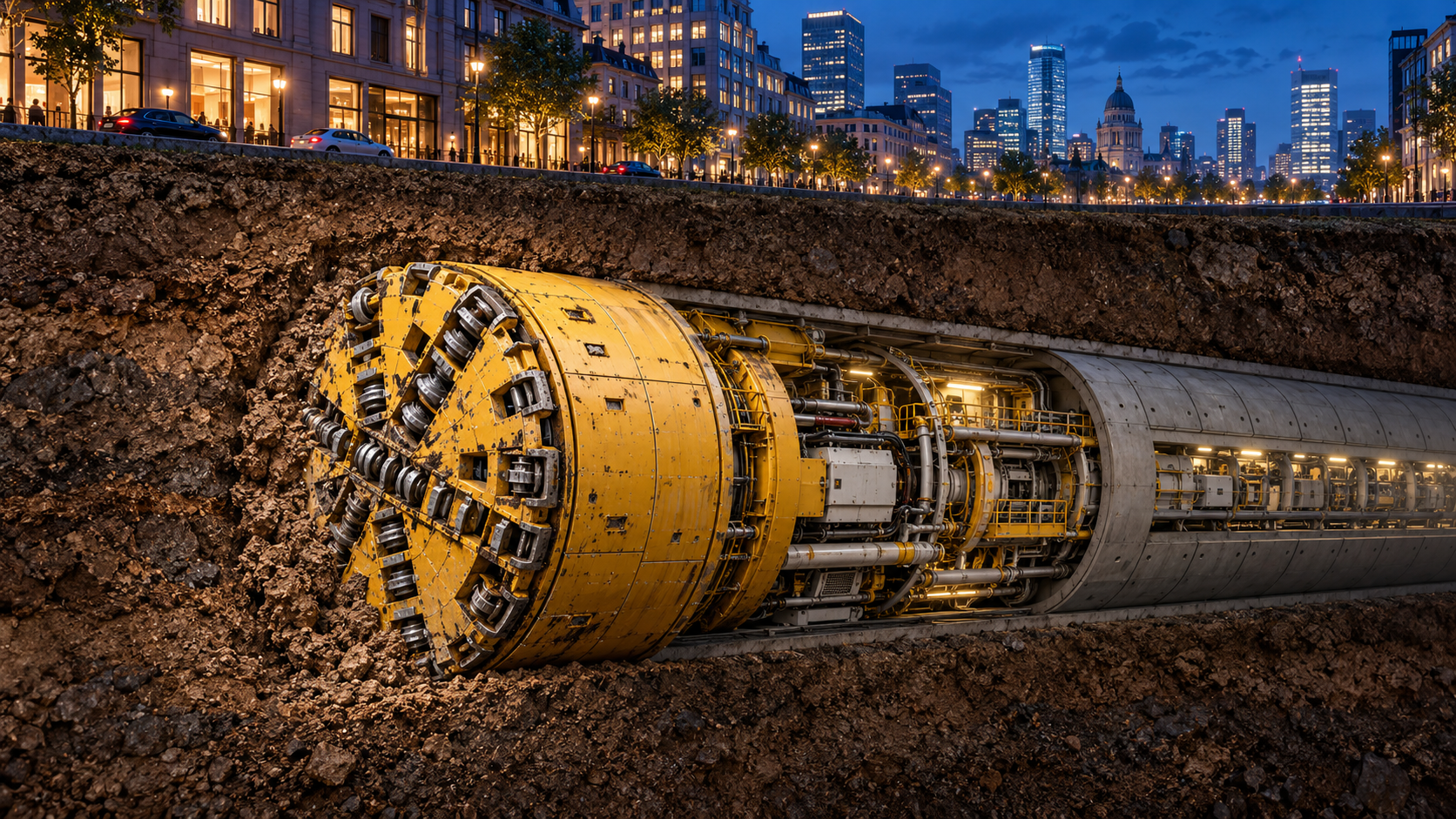
The soil becomes part of the support
In suitable ground, an earth pressure balance machine retains excavated soil in a chamber behind the cutterhead. The pressurised material supports the face and resists groundwater pressure. Conditioning additives may be needed. [1]
References belowA screw controls the flow
The screw conveyor removes material at a controlled rate. Matching discharge with advance helps regulate chamber pressure. The normal working area is behind the pressure bulkhead. [2]
References belowWhat pushes the machine forward?
Hydraulic jacks act along the tunnel axis. Their shoes bear on the end face of completed concrete lining rings, providing the reaction for forward movement. This is axial thrust, not sideways pressure against the inner wall. [1]
References belowBuild a ring. Fill the gap.
In the conventional cycle illustrated, advance pauses while an erector installs precast segments inside the shield’s tail. Grout fills the annular space outside the lining as it emerges from the shield. [2, 3]
References belowPrecision has to be measured
Engineers track ground and structure movement and review operating parameters. Crossrail’s Ranelagh Sewer case shows why monitoring matters even when EPB operation aims to minimise movement. [4]
References belowTwo millimetres — in one documented case
Robbins reports a maximum recorded settlement of 2 mm near Jaipur’s Chandpole Gate during the first tunnel drive. This project result is not a universal TBM tolerance or a guarantee of zero movement. [5]
References belowThe questions beneath the city
Do all tunnel boring machines work this way?
No. This episode focuses on a conventional EPB machine in suitable ground. Other geology and groundwater conditions can require different machines or operating modes.
Is the tunnel supported only at the front?
No. Face support, the steel shield, permanent lining and the filled tail gap perform different roles along the excavation.
Are the visuals construction drawings?
No. The AI-generated cutaways simplify geometry and motion and are not to scale. Foundations and utilities are omitted for clarity; real projects require site-specific investigation and design.
Follow the evidence.
Primary engineering references and project case studies. Numbered references correspond to the explanation above; project results are not universal guarantees.
- ITA-AITES — EPB shields: face support and longitudinal thrust
- Robbins — EPB chamber pressure, screw extraction and segment erection
- Crossrail — Tunnel Construction Methodology, D8 (planning information paper, 2007)
- Crossrail Learning Legacy — Monitoring utilities during urban tunnel drives
- Robbins — Jaipur Metro: Chandpole Gate case study
Published by MAKESTEAD · October 23, 2026 · Our sources and editorial approach