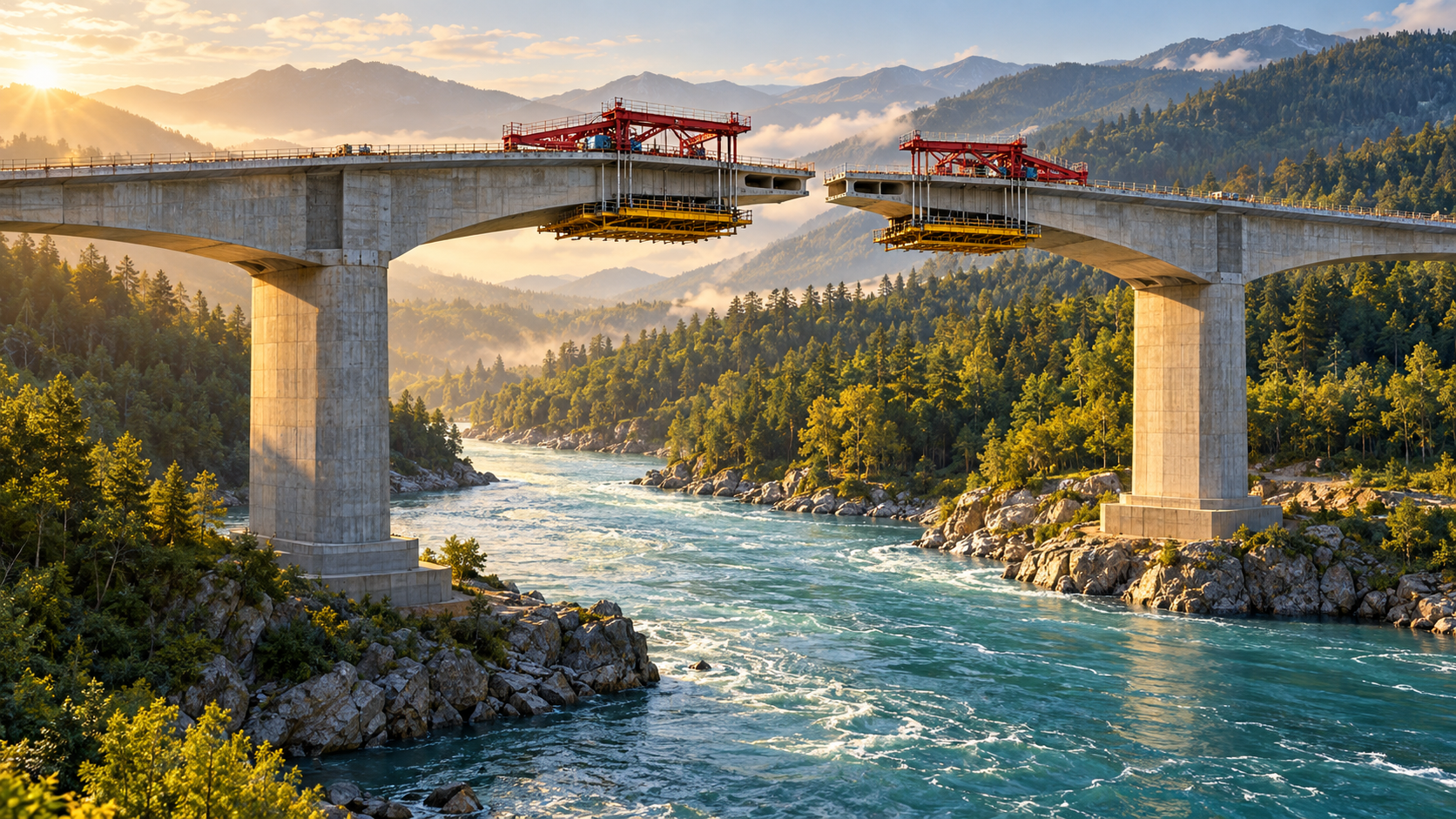
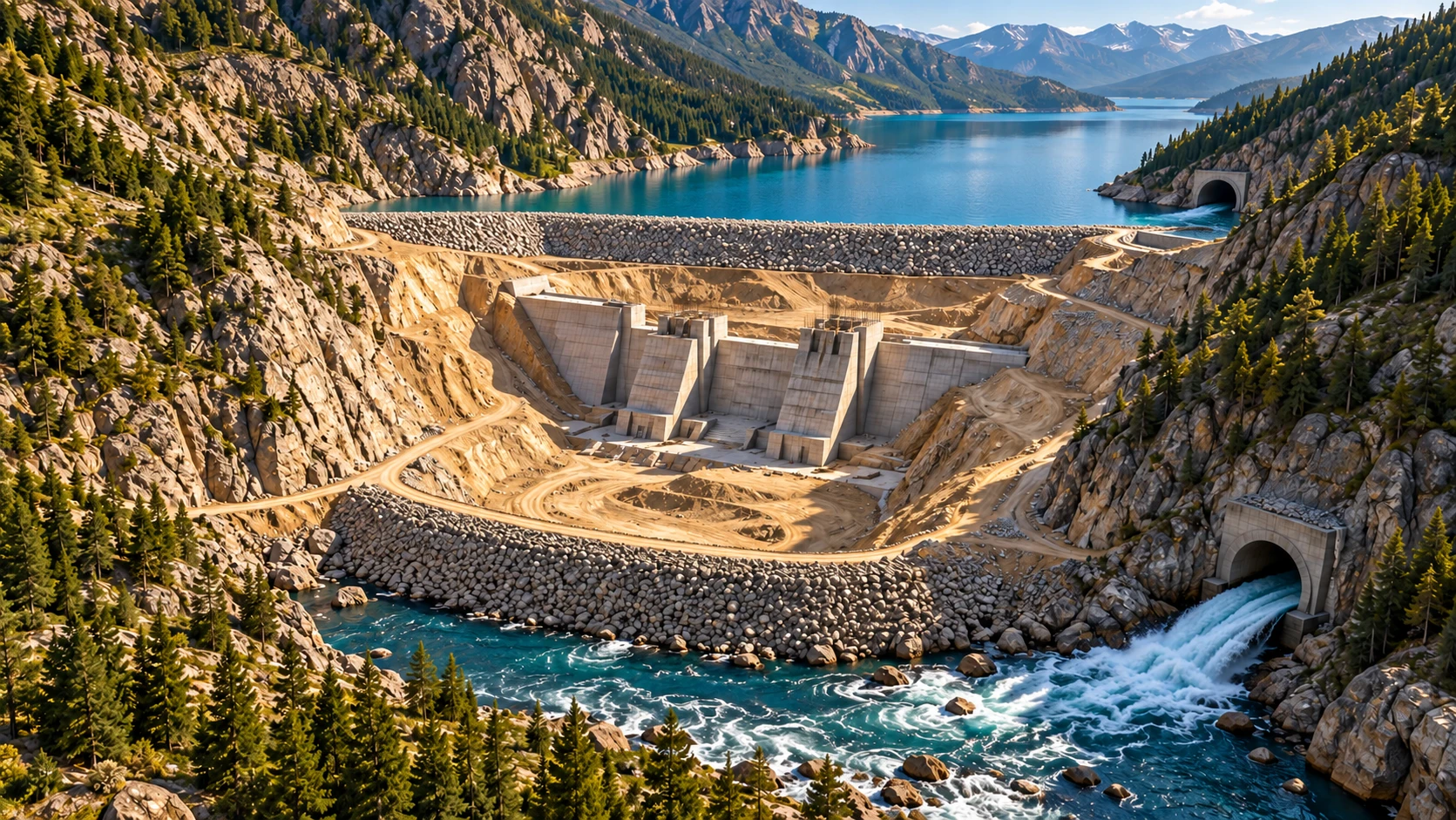
Engineers can enclose a small part of the river with a cofferdam and remove water from that work area while flow continues outside. Once suitable foundations and piers are ready, one option is to build a concrete deck outward from the piers using balanced cantilever construction. Temporary form travelers support each new segment until it can become part of the structure. Sources 1–3
Inside the episode
First control the water. Then control the balance.
A cofferdam is a temporary enclosure, not the bridge foundation itself. Its walls and bracing resist water and ground pressures. Pumps remove trapped water and manage seepage. Where required, an underwater concrete seal must gain enough strength to resist water pressure before the enclosure is drained. Source 1
Conceptual bridge construction illustration · AI-generated, not a construction drawing or a specific project.
01 · Below the deck
The load needs a path into the ground.
Piers transfer bridge loads into foundations. The foundation system depends on the soil, rock, water conditions and structural demands; driven piles, drilled shafts and spread foundations are different solutions. A visible pier alone does not reveal what lies below the riverbed. Source 4
02 · Above the river
Build outward with the imbalance controlled.
In balanced cantilever construction, deck segments extend on opposite sides of a pier. Engineers limit the difference in loads and provide the designed pier connection or temporary supports. The two arms are not simply left to balance on an unsupported pivot. Source 2
For cast-in-place segments, a form traveler carries the forms and construction loads through its frame and connections to the completed deck. After the concrete reaches the required strength and the specified prestressing is applied, the equipment can advance for the next cycle. The final closure and continuity work connect the cantilevers according to the bridge design. Sources 2–3
Questions, answered
What the animation simplifies.
Does the whole river need to be stopped?
No. A local cofferdam can isolate the area around a foundation while the river continues around it. Its layout and construction sequence must account for river levels, flow and site constraints. This is one approach, not a method suitable for every crossing. Source 1
Why does the formwork move with the traveler?
The traveler and its suspended formwork are an integrated temporary works system. Once a segment is ready for the next construction stage, the forms are released and the system is repositioned for the next segment. The equipment does not pull the completed concrete bridge forward. Source 3
Is the last connection just a concrete pour?
No. The closure is part of a planned sequence involving geometry, reinforcement, concrete strength and the bridge’s continuity and prestressing requirements. The short film condenses those operations into a visual explanation. Sources 2–3
Is every river bridge built this way?
No. Bridge type, span, ground conditions, access and river use influence the method. This episode combines local cofferdam works with a cast-in-place balanced cantilever deck to explain one possible construction approach.
About the models and visuals
The presenter, cover and construction scenes are AI-generated. Geometry, movement and connections are simplified and are not a buildable design. The sequence compresses construction time and does not show every temporary support, inspection or prestressing operation.