
Episode 17 · Engineering & materials · 1:55
How Does Underwater Welding Work?
How can an electric arc melt steel underwater? Explore the gas cavity, rapid cooling, hydrogen cracking and dry hyperbaric welding.
The key idea
Steel melts underwater. What keeps the arc alive?
- Heat and gases create a transient cavity around the arc
- Water rapidly cools the weld and affects its metallurgy
- A pressurized dry chamber displaces water around the work
Full episode · English audio
AI-generated presenter and illustrative scenes. These are conceptual visuals, not documentary footage, exact equipment diagrams or welding instructions.
Watch on YouTubeExplore the explanation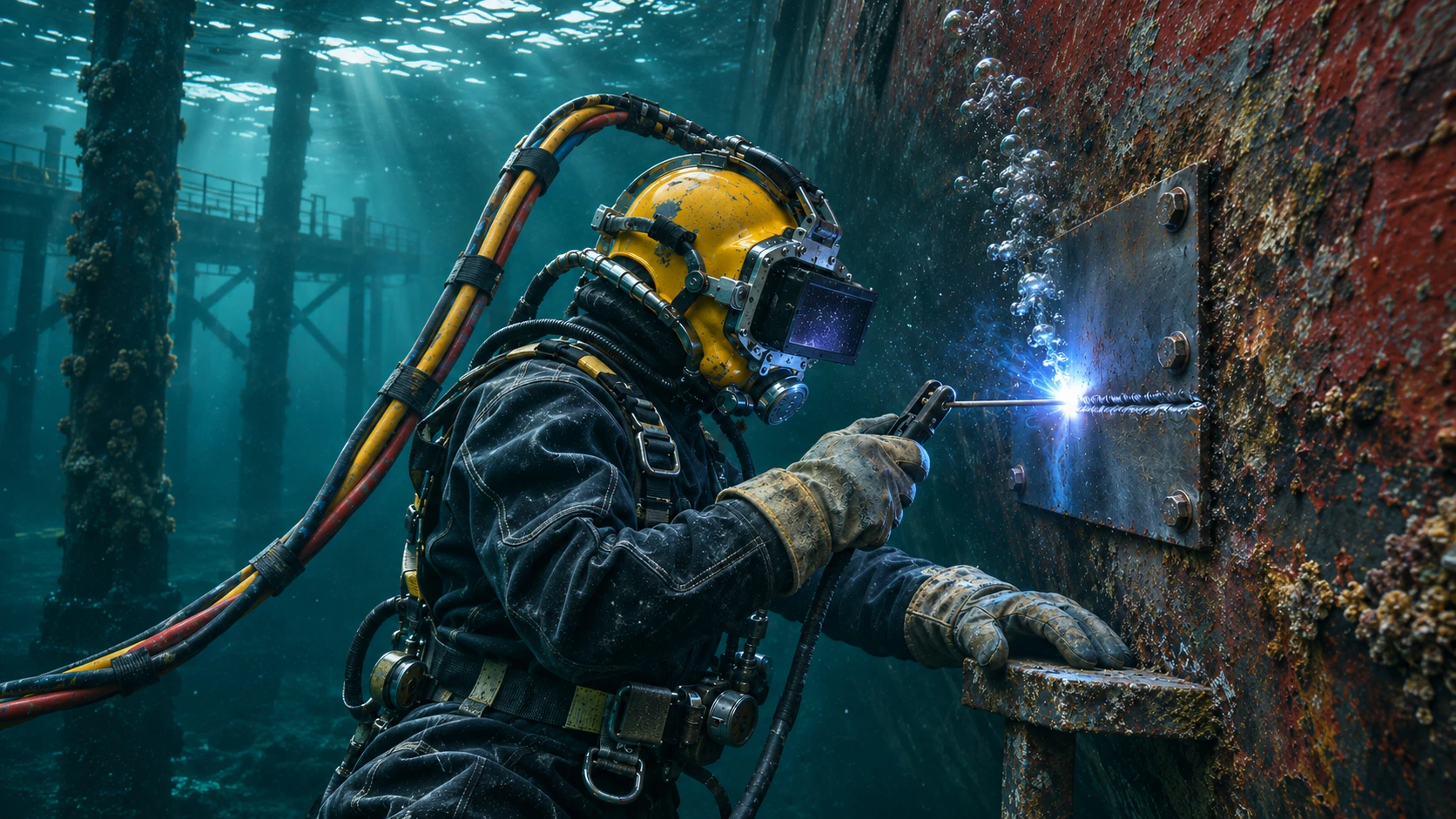
Why does the arc not simply go out?
The intense heat vaporizes nearby water, while the electrode covering and other reactions contribute gas. This creates a transient gaseous region around the arc. Bubbles grow and detach; their movement can disturb arc stability.
The challenge after the sparks stop
Rapid cooling changes the thermal cycle and can produce hard, susceptible microstructures in some steels. Hydrogen, a susceptible microstructure and tensile stress can combine to cause delayed cracking. Qualified procedures, suitable consumables and inspection matter more than the brightness of the arc.
Wet welding versus dry welding
Wet welding takes place directly in the surrounding water. Dry hyperbaric welding uses a chamber with a controlled gas atmosphere at pressure related to the working depth. It can provide better process control, but requires more complex equipment and planning.
Do the bubbles protect the diver from electricity?
No. The gas cavity explains the arc environment, not electrical safety. Commercial operations depend on specialist equipment, insulation, surface control and trained teams. This episode explains principles rather than providing operational instructions.
Questions about underwater welding
Does an underwater weld always have the same quality as a weld in air?
No. The process, steel, cooling rate, hydrogen, depth and inspection requirements influence the result. A visible bead alone does not establish integrity.
Can welding take place in a dry space underwater?
Yes. Dry hyperbaric welding uses a gas-filled chamber around the work. The chamber displaces water while its pressure is managed for the depth.
Follow the evidence
Specialist explanations from TWI and published welding research. Results depend on the process, material, depth and qualified procedure.
The key idea
The short answer
In wet arc welding, an electric arc melts the electrode and steel while heat and gases create a small, changing cavity around the arc. Water remains around the work and cools it rapidly. Dry hyperbaric welding instead uses a gas-filled chamber to displace the water locally.
Follow the evidenceMAKESTEAD · 2026-11-07 · Our sources and editorial approach